
Byoyomi Timer
The Go clock that speaks byo-yomi
Main time plus periods, Canadian overtime with a stone counter, Fischer bonus time, Ing and the NHK format — and a voice that reads the last seconds aloud, the way a human timekeeper does. Built for the board in front of you.
iPhone and iPad · works fully offline · no account, no ads, no tracking
A Go clock is a two-sided timer for a game of Go — known as Igo (囲碁) in Japan, Weiqi (围棋) in China, Baduk (바둑) in Korea and cờ vây in Vietnam. What separates it from a chess clock is byo-yomi (秒読み, "reading the seconds"): after the main time runs out, each move gets a fresh period of a few seconds instead of ending the game. Byoyomi Timer turns an iPhone or iPad into that clock, with every time system Go is actually played under.
Every Go time system, done properly
The seven systems below are what the app implements — not a chess clock with a byo-yomi mode bolted on.
Japanese byo-yomi
Main time plus a number of periods, exactly as played in Japan, Korea and China. Finish your move inside the period and it resets in full — spent seconds do not carry over. Let it run out and the period is gone for good; overrun the last one and you lose on time. The remaining periods stay on screen, and the moment main time ends is unmistakable.
Canadian overtime, with a stone counter
After main time, play a set number of stones inside a block of time — the classic 25 stones in 10 minutes. The clock counts the stones down for you, and the counter is tappable when someone miscounts. Play all of them in time and the whole block refills.
A voice that reads the seconds
Byo-yomi is named after the official who counts the closing seconds out loud. The app does the same: the last ten seconds of every period, the start of byo-yomi, the final period and every lost period. English, German, Japanese, Korean or Mandarin — independent of the app's language, so a German interface can count in Japanese. Beep-only and silent are one tap away.
Fischer, Ing, NHK and sudden death
Fischer bonus time with an optional cap — the current AGA standard. Ing overtime with its three purchasable periods and two penalty points each. The NHK television format of 30 seconds a move backed by ten one-minute reserves. Plain sudden death. Progressive overtime, where the stone quota grows each block.
Teaching games and handicaps
Both clocks are fully independent — different systems, different times, different period counts on each side. That is normal in Go for teaching and handicap games, where a stronger player takes less time or fewer periods.
Made to sit beside the board
Digits large enough to read across a goban, two halves that face opposite directions so both players see theirs upright, and generous tap zones you can hit without looking. Pass buttons are built in: two passes in a row stop the clock for counting, as the convention expects.
Referee tools
Time, periods and stones can all be corrected mid-game — for a misread counter, a phone that was picked up, or any of the small accidents a real tournament produces.
Offline and private by design
No account, no server, no analytics, no ads. Settings and history live on your device. The clock runs in airplane mode and keeps running on the Lock Screen through a Live Activity.
The app, screen by screen
Eleven shots from the running app: the clock at the board, the Time Lab, the editor for custom time systems, the Live Activity on the Lock Screen and the game history.
Each player reads their own half
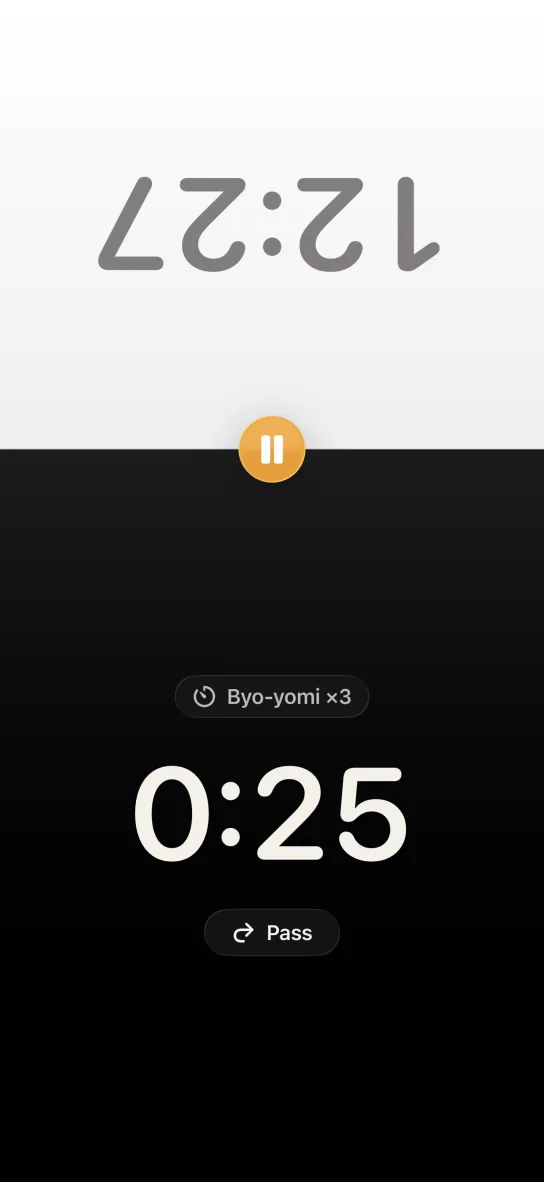
The top half is turned 180 degrees for the player sitting opposite. It holds 12:27 of main time while the bottom counts down 0:25 under a pill reading Byo-yomi ×3, with a Pass button below it.
Tap a preset and start playing
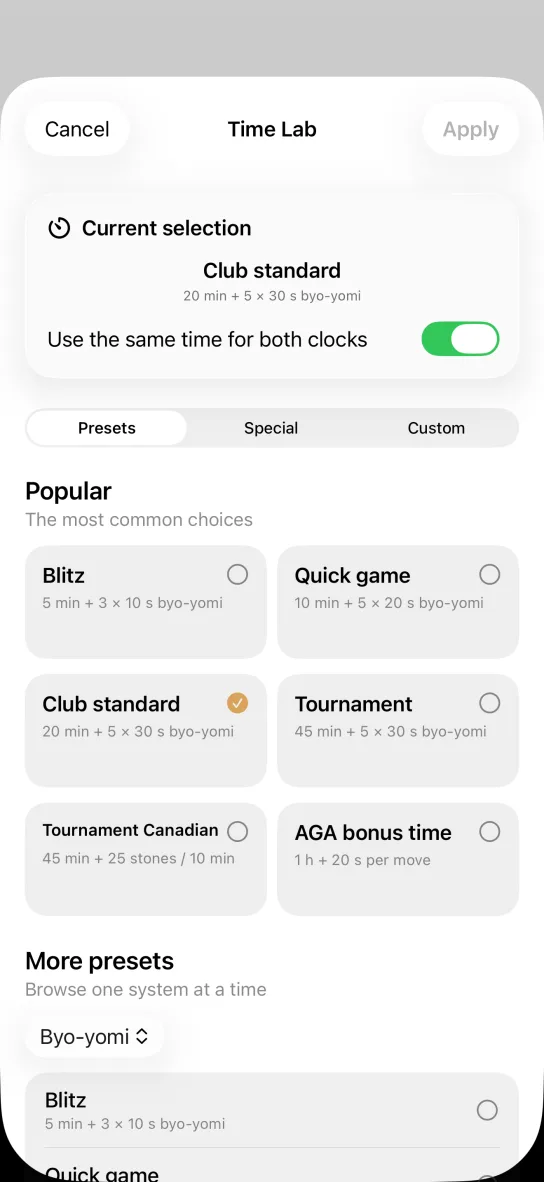
Blitz at 5 min + 3 × 10 s, Club standard at 20 min + 5 × 30 s, Tournament Canadian at 45 min + 25 stones / 10 min. The toggle at the top gives both clocks the same time; switch it off to set each side.

Browse by system, not by guessing names
Byo-yomi, Canadian, Fischer, Sudden death, Time per move, Ing overtime. Pick one and the list underneath shows only its presets — down to Title match at 3 h + 5 × 1 min.
NHK format and teaching game
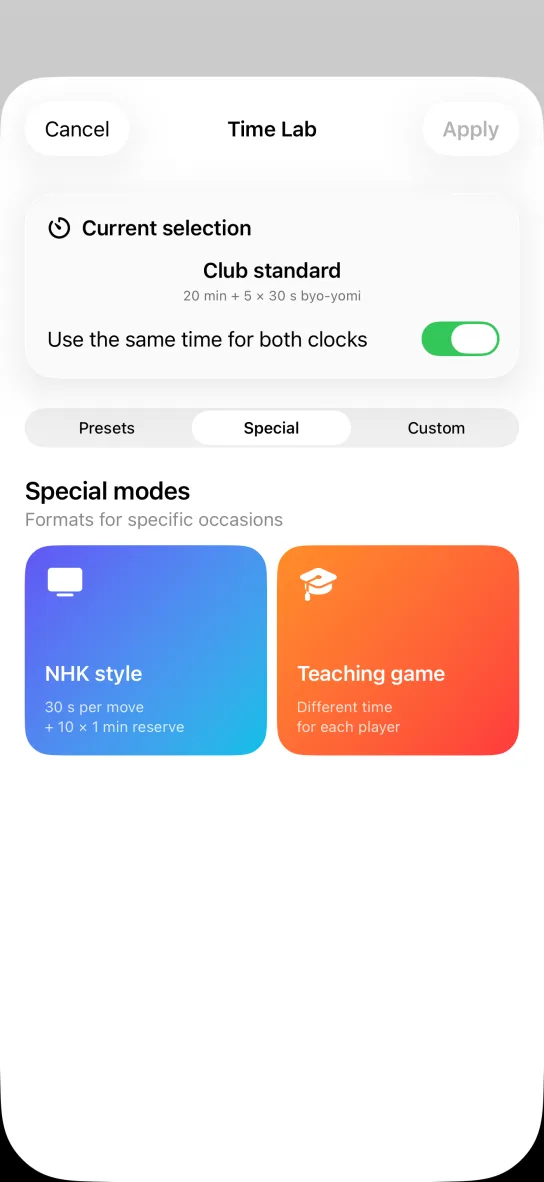
The Special tab gives both their own card instead of a line in the long preset list — the app calls them formats for specific occasions. NHK style runs 30 s per move plus 10 × 1 min of reserve.
Build a time system of your own
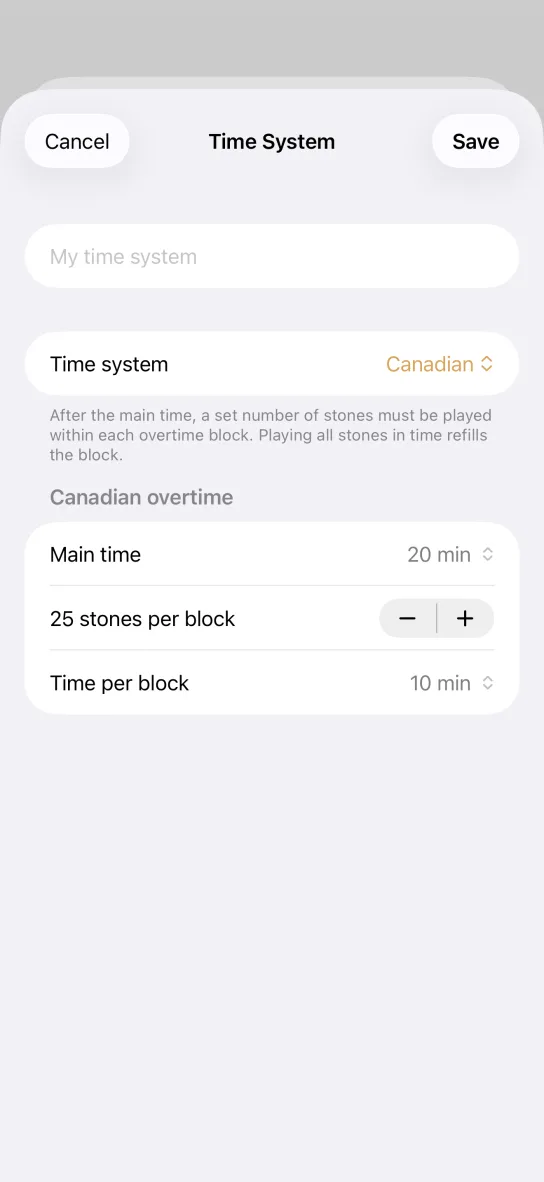
Pick the system, set the values, name it, save. Canadian asks for main time, stones per block and time per block — 20 min, 25 stones and 10 min here. A different system brings up different fields.
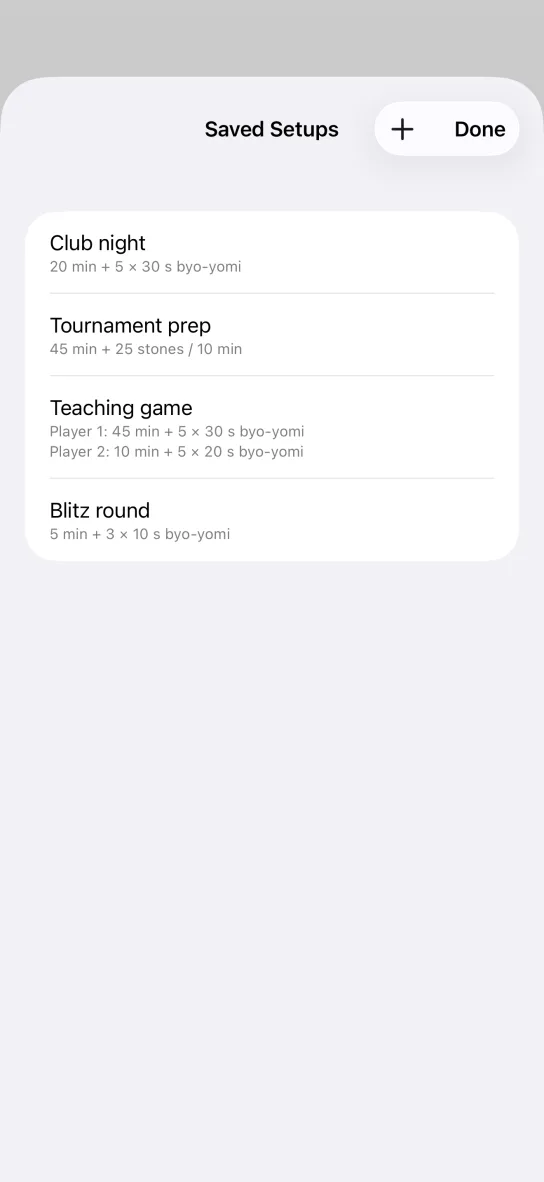
Club night is ready to go
Finished configurations under names you pick yourself. A setup can hold two different clocks: the Teaching game here gives Player 1 45 min + 5 × 30 s and Player 2 10 min + 5 × 20 s.

Both times without unlocking
A Live Activity keeps both sides on the Lock Screen: 12:27 for Player 1 on the left, 0:07 and Byo-yomi ×3 on the right.

Still in sight while you are elsewhere
On iPhones with a Dynamic Island the time stays at the top of the display — 0:19 here, with the Home Screen open in front of it.
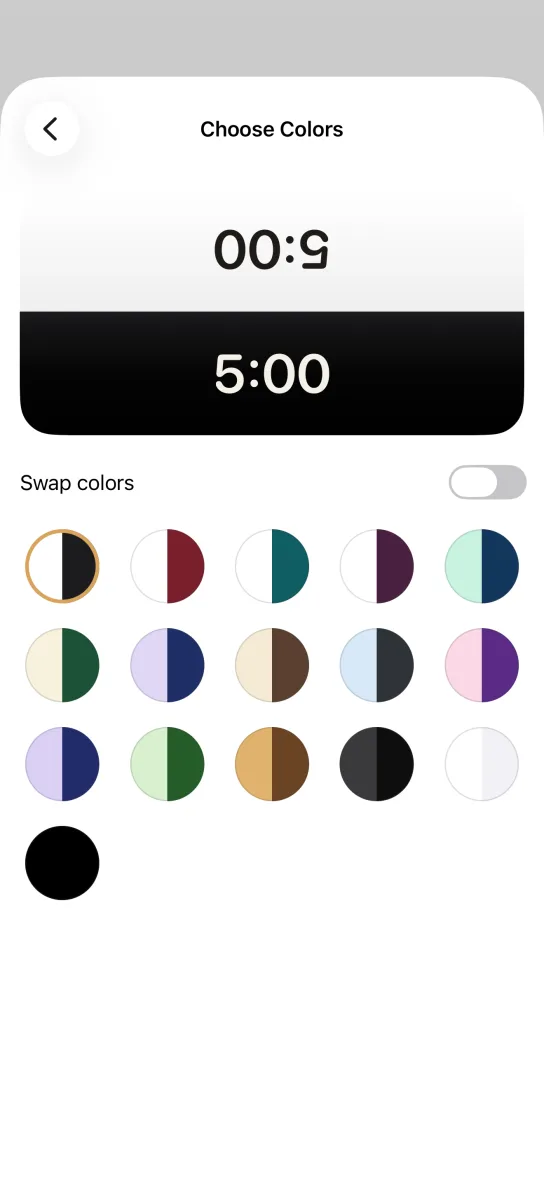
Matched to the board, not the screen
Sixteen pairs of a light and a dark half. The preview at the top shows the split clock in whichever pair you tap, and the Swap colors toggle decides which half gets which.
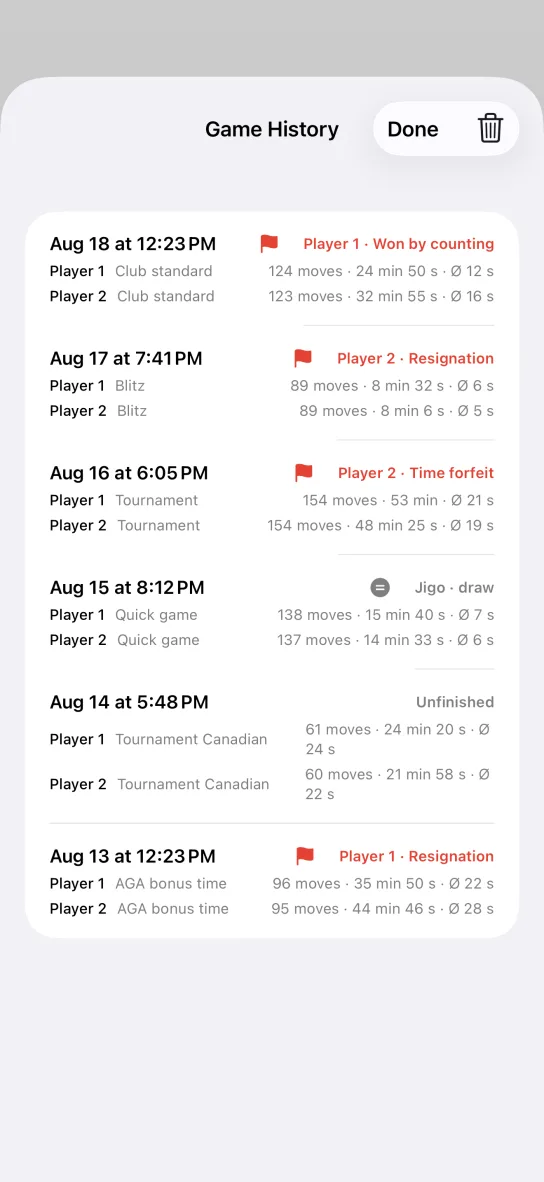
What actually happened in the game
Every finished game with each side's preset, move count, time used and average per move — and how it ended: won by counting, resignation, time forfeit, jigo or unfinished. It all stays on the device.
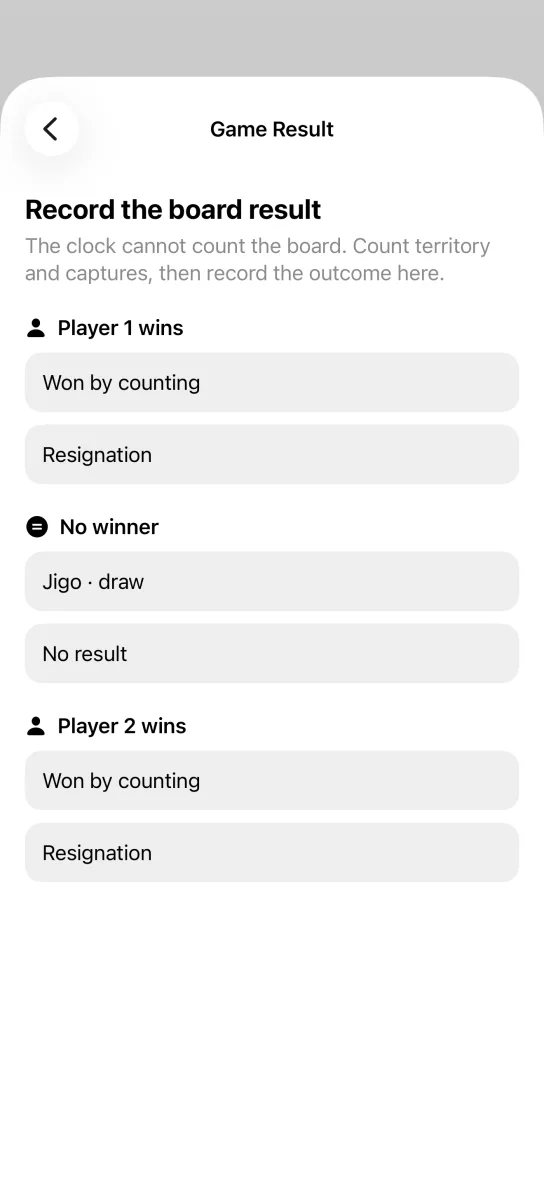
The clock says what it cannot do
A clock cannot count a board. The app admits as much, then asks only for the outcome: won by counting or resignation for either player, jigo, or no result.
Presets from a blitz game to a title match
Ready to start, and every one of them editable. Custom controls can be named and saved.
Sixteen looks, including wood and slate
Because a clock sits next to a wooden board, not on a screen full of other apps. Dark and light are both handled, and OLED black draws the least power on a long game.
It collects nothing
There is no account, no tracking, no advertising and no analytics SDK. The app never sends your games anywhere, because there is nowhere to send them: everything stays in local storage on your device. The only third-party component is the purchase system that unlocks Pro, and it identifies you by an anonymous ID — never by name or email.
Frequently asked questions
What is byo-yomi?
Byo-yomi (秒読み, Japanese for "reading the seconds") is the overtime system of Go. After your main time runs out you get a fixed number of periods — say five of 30 seconds. Complete a move inside the period and it resets to its full length; overrun it and that period is spent for good. Overrun your last period and you lose on time. The name comes from the official who used to read the closing seconds aloud.
Why not just use a chess clock for Go?
Because almost no chess clock implements real byo-yomi. A chess clock offers increment and delay, where seconds are added to one shared pool. Byo-yomi replaces the pool with a per-move deadline and a countable stock of periods, and Canadian overtime needs a stone counter that chess clocks have no concept of. That gap is exactly what this app fills.
Does the app work without an internet connection?
Yes, completely. Everything runs on the device, so the clock works in airplane mode, in a club basement or on a train. A connection is only ever needed to buy or restore Pro.
Can the interface be in one language and the countdown in another?
Yes, and that is deliberate. The spoken countdown is set separately from the interface language, so you can read a German interface while the clock counts in Japanese. The voice speaks English, German, Japanese, Korean and Mandarin.
Can the two players have different times?
Yes. Each side is configured independently — different time systems, different main times, different period counts. That covers handicap and teaching games, where the stronger player normally takes less time.
Which time systems does it support?
Japanese byo-yomi, Canadian overtime, Progressive overtime, Fischer bonus time with an optional cap, sudden death, time per move including the NHK reserve format, and Ing overtime.
What does Pro cost and what does it add?
Pro is available as a monthly or yearly subscription, or as a one-time lifetime purchase. It adds custom time systems, the tournament presets, teaching games with independent clocks, all 15 additional colour themes, sound packs, landscape mode, saved setups and game history. The core clock — byo-yomi, Canadian, Fischer, sudden death and per-move play — stays free.
Is this the official rulebook?
No. The explanations on this site describe how the time systems work in practice and how the app implements them. The rules that bind any actual game are those of the club, federation or tournament you are playing under.
Bring a proper clock to the board
Byoyomi Timer plays every system Go is played under — byo-yomi, Canadian, Fischer, Ing, NHK — and counts the last seconds out loud.

Coming soon to the App Store